Contributed by: Dr. Tamhankar & Siddarth David
Last week in New Delhi the
International
Conference on Antimicrobial Resistance was held by the
Ministry of Health and
Family Welfare, India and the World Health Organization (WHO) Regional Office
for South Asia. The conference
aimed to highlight the health and economic
problems created by excessive use of antibiotics and the measures taken to
address them.

The event
saw senior representatives from the Government
of India, join health ministers from across the region, and representatives
from industry and civil society to discuss important aspects of this global
problem. The event re-iterated the need for all the countries in the region to
adopt for
national action plan to combat the problem.
The health minister Mr. J P Nadda said that India is committed to
combating Antimicrobial Resistance (AMR). However, a collective action is
required by all stakeholders within the country and also by all countries within the
region. India, will be very happy to work with other Member States to achieve the
common goal of AMR containment. He further stated that the complexity of AMR is
also fuelled by numerous stakeholders impacting and impacted by AMR.
These
include the consumers or the patients who take the medicine, doctors who
prescribe, pharmacists who dispense, the industry which manufactures, the
Government which regulates, the research organizations which innovate, the
animal and agricultural sector which contribute to the food chain, the hospitals
which treats the patients, the Civil Society which articulates the peoples’
perspectives, and the media which can focus attention on this important issue.
Given this scenario, the Health Minister pointed out that it is imperative that
all stakeholders connected with AMR contribute to pave the way for effective
action to combat AMR. He also pointed out to the grave economic consequences
that countries across the world are facing due to non-rational use of
antibiotics. He emphasized on correct prescription practices, prescription
audits and digital repository of patients’ medical history among other
important measures to be taken to combat the growing misuse of antibiotics. He
extended India’s commitment and resolve to work with other countries towards
combatting this problem.
 Also present at the conference were, Mr. Tandin Wangchuk, Health Minister of Bhutan; Mr.
Ram Janam Chaudhary, Health Minister of Nepal; Mr. Mohamed Habeeb, Minister of
State for Health, Maldives; Dr. Poonam Khetrapal Singh, Regional Director,
World Health Organization, South East Asia Region and Dr. Keiji Fukuda,
Assistant Director General, World Health Organization.
Also present at the conference were, Mr. Tandin Wangchuk, Health Minister of Bhutan; Mr.
Ram Janam Chaudhary, Health Minister of Nepal; Mr. Mohamed Habeeb, Minister of
State for Health, Maldives; Dr. Poonam Khetrapal Singh, Regional Director,
World Health Organization, South East Asia Region and Dr. Keiji Fukuda,
Assistant Director General, World Health Organization.
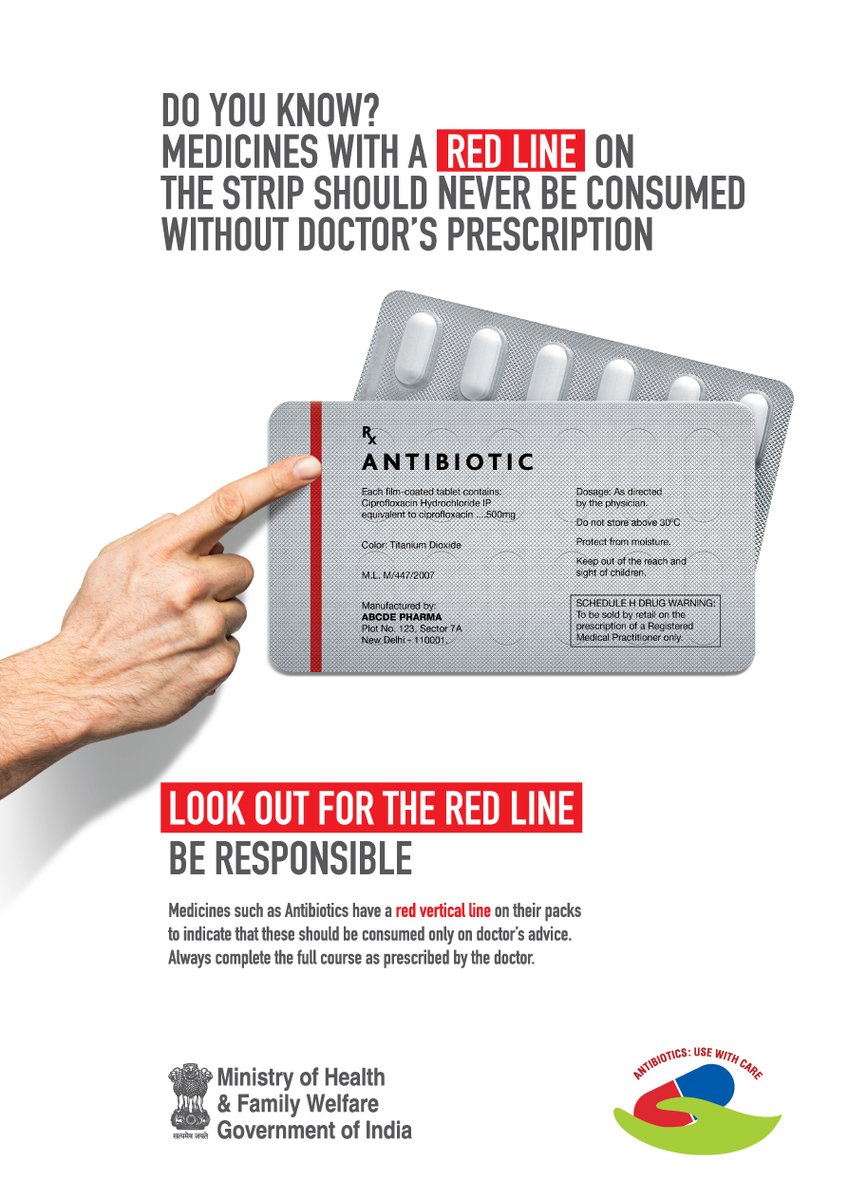
The Indian health minister also used the platform to
launch the media campaign of
'Medicine strips with
Red Line' that sought to help create mass awareness against misuse of antibiotics.
This event was in keeping with the 68
th session of the World
Health Assembly proceedings
presided over by India in Geneva in May 2015 which adopted a Global Action
Plan on antibiotic resistance . It planned to
prepare a blueprint with specific actions and timelines for the WHO as well as
member states to address the growing threat of resistance.
In the coference, Dr. A.J. Tamhankar, national coordinator of Indian Initiative for Management of Antibiotic Resistance (IIMAR) was invited to present his views on "Role and Perspectives of Civil Society in combating Antimicrobial Resistance". IIMAR expressed the views that
- Civil society
and Governments or institutions (WHO) should have a Symbiotic Relationship.Civil groups should be used as Ears,
Eyes
and
Extended
appendages by institutions/Govt.- EEEs. Eyes and ears for getting information from
society; Appendages for spreading useful messages.
- Healthcare worker`s organizations
should be used extensively to create awareness. Scientists, microbologists,
Healthcare Workers should be encouraged to form local civil Societies to
spread AMR
awareness.
- Antibiotic residues
and Antibiotic resistant bacteria in Environment, Antibiotic use in Animals
(both therapeutic and growth promoters),
and industrial effluents
are a major
threat and must be given due importance in policies on AMR containment. Current emphasis on Clinical and human AB/ABR monitoring and related
interventions alone will NEVER solve
the AMR
problem.
- Following
“Location
Specific
Integrated
Antimicrobial Resistance management strategy
” (Tamhankar,
2008).
And A
“One Health approach” (For Role model -see
'Protocol
paper
on one health' -BMC public health, 2015) is the need of the hour.
- (On behalf of Dr. Tamhankar, Dr. Ramesh Nachimuthu, Joint Coordinator, IIMAR presented the views).
The deliberations were conducted in the following 9 session:
1. Antimicrobial
Resistance: The Global Picture and follow up on WHA Resolution. Chair : Dr Poonam Khetrapal
Singh, Regional Director, WHO, SEARO,
Co Chair: Mr B. P. Sharma, Secretary Health, MoHFW
2. Rational use of
antimicrobials, Chairs: Hon’ble Mr Ramjanam Chaudhary, Minister of Health,
Ministry of Health, Co-Chair: Prof(Dr.) Jagdish Prasad, DGHS
3. AMR in health care setting: Infection prevention and
Control, Chair: Dr Carmem Lúcia Pessoa-Silva, WHO HQ, Co-Chair: Dr Rajesh Bhatia
4. Policy/Strategy perspective for combating AMR:
International experiences, Chair : Dr S. Venkatesh, Director, National Centre for Disease Control, New Delhi, Co Chair: Professor Thet
Khaing Win (Mr) Permanent Secretary, Ministry of Health, Myanmar.
5. Surveillance for AMR in humans, animals and the environment,
Chairs : Prof. Dame Sally Davies, Chief Medical Officer, UK, Co-Chair: Dr Henk
Bekedam, WHO Representative to India.
6. Industry
Perspectives: R &D on Combating AMR and Follow up on the Industry Declaration on AMR, Chairs :
SEAR Minister ( Bhutan) Co-Chair: Dr Sudanshu Pant, JS, Department of
Pharmaceuticals, MoHFW
7. Role of Regulatory Authorities in
combating AMR, Chair : Mr Pawan Aggarwal, CEO, FSSAI, Co-Chair: Mr KL
Sharma, JS (Drugs), MoH&FW
8. Research and Innovation for Combating
AMR, Chairs: Dr SoumyaSwaminthan, Secretary DHR and DG ICMR, Co-
Chair: Prof. Vijay Raghavan, Secretary, DBT
9.
Civil society Perspectives for Combating AMR( Panel Discussion) Chairs : Dr AK Panda, Addl Sec, MoHFW, Co-Chair:
Dr Arun Thapa, DPM, SEARO